BVN and OTP Scams: Why You Should Never Share These Codes
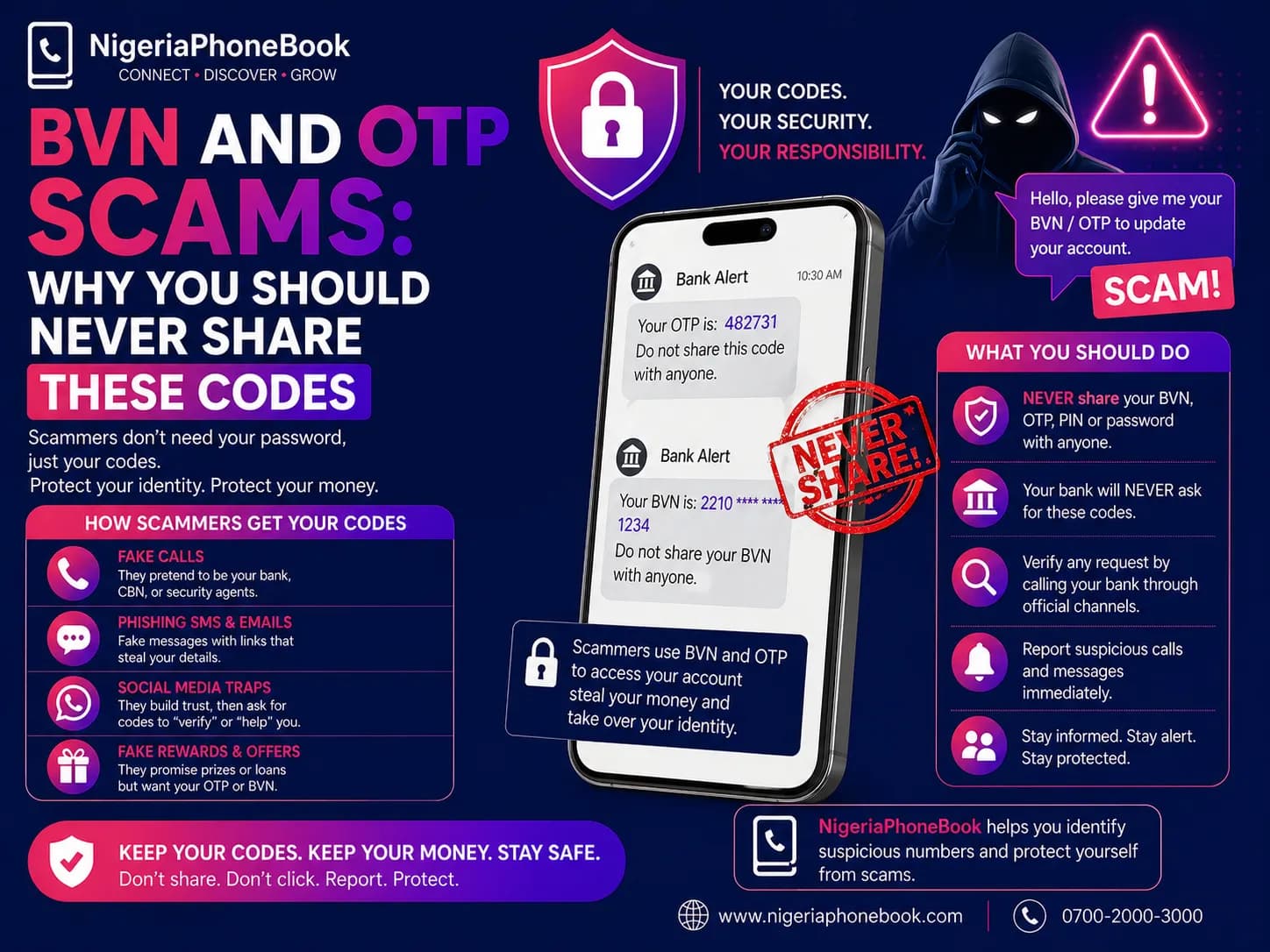
Your BVN (Bank Verification Number) and OTP (One-Time Password) are the two most valuable pieces of information a scammer can get. Together, they can drain your bank account in minutes.
What Is a BVN?
The BVN is a unique 11-digit number that identifies you across all Nigerian banks. It's linked to your biometric data and every bank account you own. It was introduced by the CBN in 2014 to fight fraud.
What Is an OTP?
An OTP is a temporary code sent via SMS or generated by an app, used to authorize transactions. It's designed to verify that YOU are the one making a transaction — not someone else.
How Scammers Steal Them
The BVN Trick
A scammer calls pretending to be from your bank: "We're updating our records. Please confirm your BVN." Once they have it, they use it to impersonate you across banking platforms.
The OTP Trick
The scammer already has some of your details (name, account number, maybe even BVN). They initiate a transfer on your account. When your bank sends you the OTP to confirm, they call and say: "This is your bank. We're testing our fraud alert system. Please read us the code we just sent you."
The moment you read the code, the money is gone.
Never, Ever Share
- Your BVN with anyone who calls you
- Your OTP with anyone — even someone claiming to be from your bank
- Your ATM PIN over the phone
- Your online banking password
- Your debit card CVV
What Real Banks Do
- Banks never ask for your PIN, OTP, or CVV
- Banks never call and ask you to "confirm" your BVN over the phone
- Bank fraud desks only handle cases you initiate yourself
- Bank emails come from official domains, not Gmail or Yahoo
If You Shared an OTP by Mistake
Act within minutes:
- Call your bank immediately on their official number
- Report the incident and freeze your account
- Change your online banking password
- File a police report for documentation
- Report to the EFCC
- Report the scammer's number on NigeriaPhoneBook
The first few minutes are critical. Every minute counts.
Prevention Is the Best Cure
- Treat your OTP like your PIN — never share it
- Be suspicious of urgency: "Act now or your account will be closed"
- Hang up and call your bank directly
- Keep your phone number private on social media
- Enable app-based authentication where possible
- Turn on transaction alerts for every kobo movement
Your money is yours. Don't let a smooth-talking scammer convince you otherwise.
Written by
NigeriaPhoneBook Team
Contributor at NigeriaPhoneBook. Writing about scam awareness, digital safety, and protecting consumers from fraud.